Google Nest Learning Thermostat 3rd Gen
An advanced thermostat controls residential and small commercial Heating, Ventilation, and Air Conditioning (HVAC) equipment while communicating with other systems, and uses computational capability to provide advanced functionality, such as including additional sensors, the ability to group multiple thermostats, energy reports, and/or notifications.
Learn MoreIf you are experiencing issues with the comparison tool, please disable your adblocker.
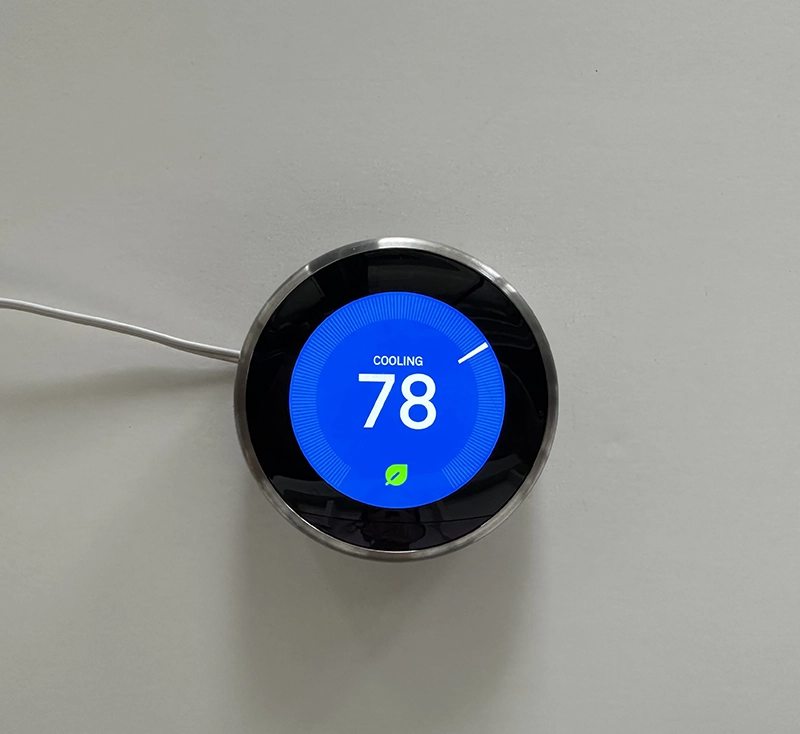
Google Nest Learning Thermostat 3rd Gen
The Google Nest thermostat supports up to three heating/two cooling stages (conventional), and two heating/cooling stages with auxiliary heat (heat pumps). Nest learns temperature preferences to create a schedule and has an on-board occupancy sensor. Its Rush Hour Rewards program enables participation in utility demand response. Nest connects through Wi-Fi.
Hub Highlights:
- On-board motion (occupancy) sensor and outdoor temperature through Internet weather
- Pairs with other systems (cameras etc)
| Model Number | T3007ES |
| Primary Setting | Residential |
| User Interface Options | Mobile app (Nest) |
| Multiple Thermostat Control | N/A |
| Access Restriction | Can lock heat or cool temperature settings to prevent others from changing settings or changing the temperature outside of a restricted range |
| Notifications/Reports | Alerts (heat/cooling not working, power failure, filter) Energy reports |
| Available Sensors | On-board relative humidity and motion (occupancy) sensor Outdoor temperature through Internet weather Pairs with other systems (cameras etc) |
| Demand Response Capable | Can participate in Utility Demand Response programs; Open Automated Demand Response (OpenADR) capable |
Last Edited on: 07/2023
| Model | T3007ES |
| Sample Size | 1 |
|
Thermal sensor accuracy (@68F)
|
2.7±0.3 °F |
|
Thermal sensor accuracy (@75F)
|
2.6±0.1 °F |
|
Impact of surrounding surface temperature on Thermal sensor accuracy
|
Very good |
|
Standby power
|
0.09 W |
Last Edited on: 10/03/24
Data Collection
The technology evaluation team performed a heuristic evaluation of basic thermostat modes of operation (turning on, changing setpoint, reading display) for each of the tested products. In heuristic evaluations assess user interfaces according to guidelines for the design of user-friendly systems.
Sample Size
1
Estimated Usability
Good: likely good usability in most tasks; Fair: likely fair usability in most tasks.
Fair