Enel X JuiceBox Pro 32
Electric Vehicle Supply Equipment (EVSE) refers to the systems that manage the transfer of electrical energy between the power grid and electric vehicles. These devices regulate charging power, ensure safe communication between the vehicle and the electrical supply, and support a range of charging capabilities from basic AC charging to high-power DC fast charging. Modern EVSE may also enable advanced functions such as bidirectional energy flow, depending on equipment design and vehicle compatibility.
Learn MoreIf you are experiencing issues with the comparison tool, please disable your adblocker.
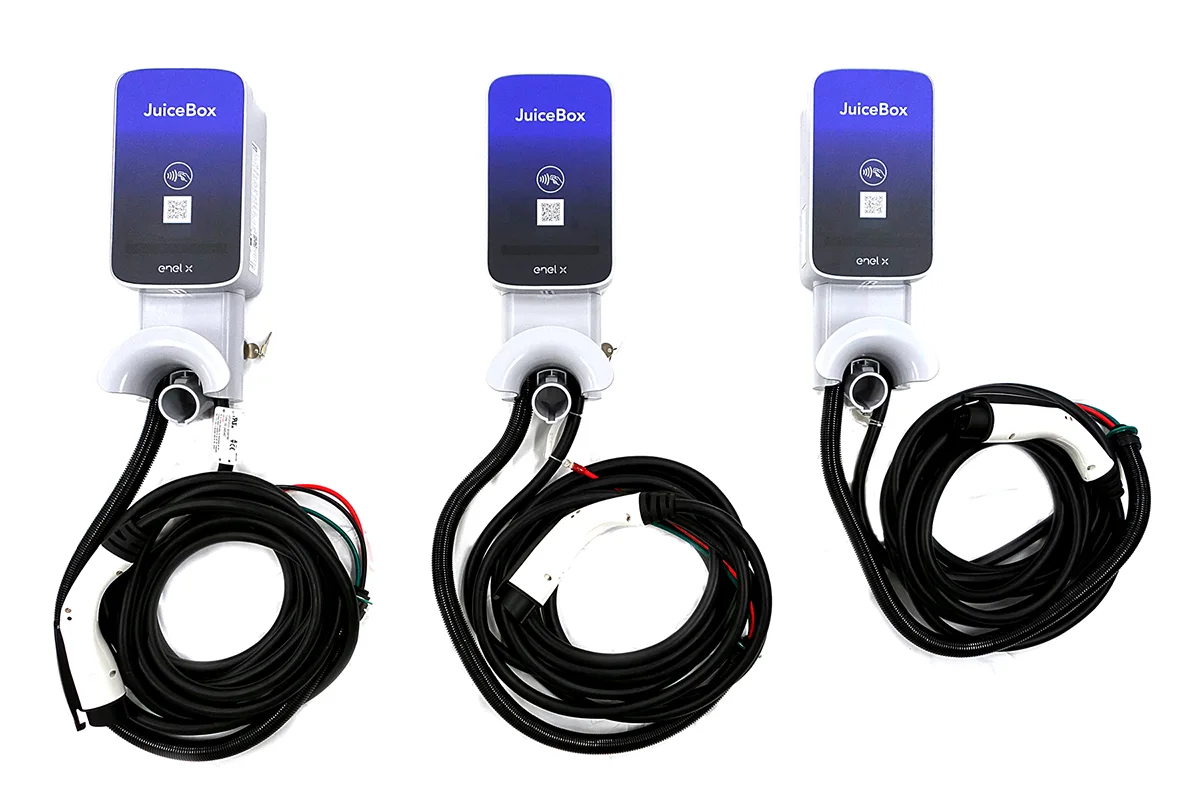
Enel X JuiceBox Pro 32
The Enel X JuiceBox Pro 32 AC Level 2 EV charger can deliver up to 32 amps of charging current or 7.7 kW charging power. The unit comes wall mount ready and can be configured as a pedestal mount with an optional stand or pedestal.
Hub Highlights:
- Provide up to 32 A or 7.7 kW output
- Compatible exclusively with Enel X JuiceNet smart charging platform
Last Edited on: December 2025
| Model Number | 2JBO321CNA-HJWR-300 |
| Rated Maximum Output Power | 7.7 kW |
| Rated Maximum Output Amperage | 32 A |
| Adjustable Maximum Output Power Options | Data unavailable |
| Adjustable Maximum Output Amperage Options | 0-32 A |
| Nominal Input Voltage | 208-240 VAC |
| Power Measurement Accuracy | Unspecified |
| Charging Cable Length | 25 ft |
| User Interface | LED Status Indicator |
| Access Control Options | RFID, QR Code |
| Local Area Network (LAN) Connectivity | 2.4 GHz Wi-Fi |
| Wide Area Network (WAN) Connectivity | 4G LTE Cellular (Optional) |
| Charging Network Communication Protocol | OCPP 1.6J |
| Mounting Type | Wall Mount |
| Operating Temp | -40°F to 140°F |
| Maximum Operation Relative Humidity | Unspecified |
| Rated for Outdoor Use | Yes |
| Compatible Charging Network Platform | Enel X JuiceNet |
| ENERGY STAR Certified | Yes |
Last Edited on: March 18, 2024
| Sample Size | 3 |
|
Power consumption when the EVSE is not connected to a vehicle
|
0.42 W |
|
Power consumption when the EVSE is connected to a vehicle but not ready to supply energy (e.g. user not authenticated to use the charger)
|
0.42 W |
|
Power consumption when the EVSE is connected to the vehicle and ready to supply energy, but the vehicle is not ready to accept energy
|
0.32 W |
|
Power consumption when the EVSE is connected to the vehicle and ready to supply energy, and the vehicle is ready to accept energy, but no power is actively delivered to the vehicle
|
1.09 W |
|
Power consumption when the EVSE is delivering energy to the vehicle at a constant rate of 4A
|
2.48 W |
|
Power consumption when the EVSE is delivering energy to the vehicle at a constant rate of 16A
|
16.38 W |
|
Power consumption when the EVSE is delivering energy to the vehicle at a constant rate of 30A
|
54.26 W |
|
Power consumption when the EVSE is delivering energy to the vehicle at a constant rate of 32A
|
61.85 W |
|
Is the EVSE verified to be capable of stopping charging in response to a demand response signal?
|
Verified |
|
Is the EVSE verified to be capable of slowing the charge rate (reducing the current supplied to the vehicle) in response to a demand response signal?
|
N/A |
Last Edited on: December 2025
Data Collection
Product evaluators at the UC Davis California Lighting Technology Center identified and assessed system characteristics related to user experience.
Sample Size
3
User Interface/Installation
Describe interface for commissioning
App
User Interface
Describe interface for end users
App, RFID device/card
Installation
What are mounting options for the unit?
Wall-mounted
Operation/Maintenance
Does the EVSE require service contracts for ongoing data access?
No
Operation/Maintenance
Warranty length?
3 years
Operation/Maintenance
What is the method for warranty claim?
Call or email
Integration/Reporting Capabilities
Can the system report usage statistics?
Yes
Integration/Reporting Capabilities
Can the system report real time status?
Yes